Homeowner Guides
How to Change Your AC Filter
Five minutes, no tools, and it's the single most impactful thing you can do for your system. Here's how to find the filter, read the size, and avoid the mistakes we see every week.
Same-day appointments · Serving Antioch, TN 37013
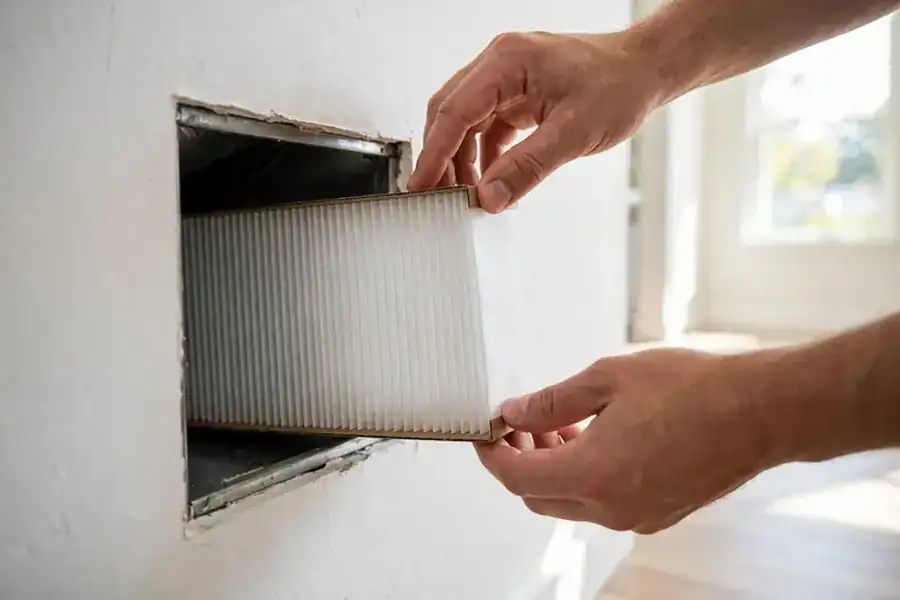
Turn the system off at the thermostat, find the filter slot, note the size printed on the old filter's frame and the direction of its airflow arrow, slide the new filter in with the arrow pointing toward the blower, and turn the system back on. That's the whole job – it takes five minutes. The parts people get wrong are finding the filter in the first place and buying the right type, so let's cover both.
Where Your Filter Hides
There are two common setups in Antioch homes. The first is a return grille – usually a large vent in a hallway wall or ceiling with hinges or latches. Open it and the filter sits right behind it. The second is a slot in the air handler or furnace itself, often in a closet, garage, or attic, marked by a thin removable cover. In Hickory Hollow's 1970s and 80s ranch homes, we often find the filter behind a hallway return grille that's been painted shut more times than anyone can count – a putty knife and some patience will open it. If you have multiple return grilles, there's a filter behind each one, and yes, you have to change all of them.
Reading the Size (Don't Guess)
The size is printed on the cardboard frame of your current filter – something like 20x25x1 or 16x25x4. Buy that exact size. The numbers are length by width by thickness in inches, and the actual filter is slightly smaller than the nominal size so it slides in. If the old filter is missing entirely, measure the slot opening and round to the nearest inch. A filter that's even a half inch short lets unfiltered air bypass around the edges, which defeats the purpose and cakes the evaporator coil with dust.
MERV Ratings, Explained Honestly
| Filter type | MERV range | Good for | Watch out for |
|---|---|---|---|
| Basic fiberglass | MERV 1–4 | Protecting the equipment on a budget | Catches little dust; change monthly |
| Pleated | MERV 8 | Most homes – the safe default | Very little; our standard recommendation |
| Pleated, high-efficiency | MERV 11–12 | Allergy households with a modern system | Check airflow; change on schedule |
| HEPA-style deep pleat | MERV 13+ | Only if your system was designed for it | Can starve older blowers and freeze coils |
Here's the myth to correct: higher MERV is not automatically better. A denser filter restricts airflow, and older systems with original blower motors – common across Davidson County's 80s and 90s housing stock – can struggle to pull air through a MERV 13. Restricted airflow freezes evaporator coils, and then you're calling us for a problem a cheaper filter would have prevented. MERV 8 pleated is the sweet spot for most homes. If allergies are a real concern, talk to us before jumping to MERV 13 – there are better ways to clean your air that don't choke the system.
Step-by-Step: The Swap
- Turn the system off at the thermostat so the blower isn't running while the slot is open.
- Remove the old filter and note two things: the printed size and the airflow arrow direction.
- Check the slot for dust buildup and wipe it out with a damp cloth.
- Slide the new filter in with the arrow pointing toward the blower – into the wall at a return grille, toward the unit at an air-handler slot.
- Close everything up and turn the system back on. Write the date on the filter frame with a marker so you know when you changed it.
Mistakes to Avoid
Running the system with no filter at all "just for a few days" is the big one – dust coats the evaporator coil fast in a Tennessee summer, and a dirty coil is a service call. Installing the filter backwards is the runner-up; the arrow matters because filters are built to load dust on one side. And don't stock up on the wrong size in bulk – measure once, then buy a case of the right ones so there's always a fresh filter in the closet when you need it.
How Often in Middle Tennessee
Check monthly from May through September and change it when it looks gray – for most Antioch homes that's every 1 to 2 months in summer. Homes with dogs, cats, or nearby construction dust may need it monthly. In the cooler months, every 2 to 3 months is usually fine. Set a phone reminder for the first of the month; it's the cheapest habit in homeownership.
Your Questions, Answered
What size air filter does my AC need?
The size is printed on the cardboard frame of your current filter – for example, 20x25x1. Buy that exact size. If the old filter is missing, measure the slot opening and round to the nearest inch. A filter that's too small lets dusty air bypass around the edges.
How often should I change my AC filter in Tennessee?
Check it monthly from May through September and change it when it looks gray and clogged – that's often every 1 to 2 months in summer here. Homes with pets or heavy dust may need monthly changes. In winter, every 2 to 3 months is usually fine.
Is a higher MERV rating always better?
No. Higher-MERV filters trap smaller particles but also restrict airflow more. On older systems with weaker blowers, a very dense filter can starve the system and freeze the evaporator coil. MERV 8 pleated is a safe default for most homes.
Which way does the arrow on the air filter point?
The arrow must point toward the blower – in the direction the air flows. At a wall return grille, the arrow points into the wall. At the air handler slot, it points toward the unit. Backwards filters load up unevenly and restrict airflow.
Can a dirty filter really damage my AC?
Yes. A badly clogged filter chokes airflow, which can freeze the evaporator coil, overheat the blower motor, and drive up energy bills. It's the most common preventable cause of the service calls we run in Antioch.