AC Troubleshooting
AC Won't Turn On? Here's What to Check
Before you assume the worst, work through these five safe checks. They take about ten minutes, need no tools, and resolve a surprising number of no-start calls we get across Antioch.
Same-day appointments · Serving Antioch, TN 37013
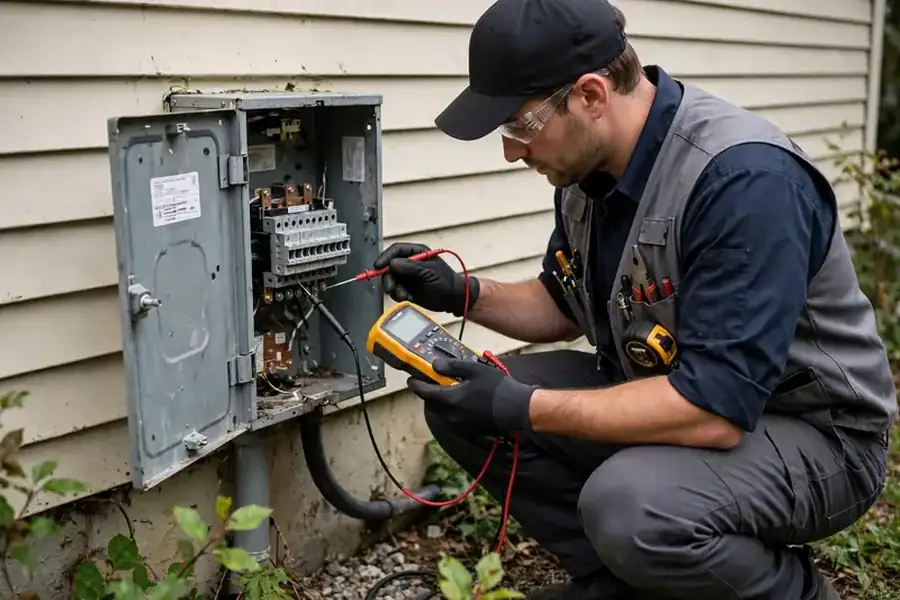
When an AC won't turn on, the answer is usually simpler than you'd expect: dead thermostat batteries, a tripped breaker, a tripped float switch in a clogged drain pan, or the outdoor disconnect switched off. These five checks cover the causes behind most no-start calls, and every one is safe for a homeowner. What they don't cover – anything inside the electrical panel or the sealed refrigerant system – belongs to a technician, because capacitors hold a charge even with the power off.
The Five-Check Routine
- Check 1 – Thermostat. Set it to COOL and drop the set point at least 3 degrees below the room temperature. If the screen is blank, put in fresh batteries. A surprising number of "dead AC" calls end right here.
- Check 2 – Breaker box. Find the breaker labeled AC, air handler, or furnace and flip it fully to OFF, then back to ON. Breakers can trip halfway and look fine at a glance. If it trips again, stop and call – that's a symptom, not a fix.
- Check 3 – Drain pan float switch. Go to the indoor unit and look for the drain pan underneath. In Middle Tennessee humidity, condensate drain lines clog with algae constantly; when the pan fills, the float switch shuts the whole system down to protect your ceiling. If there's standing water, that's your answer. A wet/dry vacuum on the outside end of the drain line often clears it.
- Check 4 – Outdoor disconnect. There's a gray shutoff box near the condenser. Make sure it's fully seated in the ON position – these get bumped during yard work more often than anyone admits.
- Check 5 – Indoor power switch. Many air handlers and furnaces have a regular light-style switch nearby, sometimes mistaken for a light switch and flipped off by accident. Make sure it's on.
What Each Result Tells You
| Symptom | Likely cause | Your next step |
|---|---|---|
| Nothing happens at all – no fan, no click | Power issue: batteries, breaker, disconnect, or float switch | Work the five checks above |
| Thermostat screen is blank | Dead batteries, or float switch cut power to the stat | Fresh batteries, then check the drain pan |
| Indoor fan runs, outdoor unit silent | Outdoor breaker tripped, failed contactor or capacitor | Reset the outdoor breaker once; call if it stays dead |
| Outdoor unit hums but won't start | Failed start capacitor | Turn the system off and call – don't let the motor cook |
| Breaker trips immediately on reset | Shorted wire, seized compressor, or failed component | Leave it off and call a technician |
| System starts, then shuts off in minutes | Frozen coil, clogged drain, or overheating motor | Check the filter and drain; call if it repeats |
When to Stop Checking and Call
Here's our honest line: if the five checks don't bring it back, or anything smells like burning plastic, or you hear loud buzzing from the outdoor unit, it's time for a pro. Summer power surges after Tennessee thunderstorms take out capacitors and control boards regularly in older Antioch ranch homes, and a board replacement is not a homeowner job. And remember the breaker rule – a breaker that trips twice is protecting you from something. Forcing it back on risks the compressor, and a compressor is the most expensive part in the system. We run 24/7 emergency calls for exactly this situation, so a dead AC at midnight doesn't have to wait until morning.
A Note on Una and the Older Housing Stock
In neighborhoods like Una, where many homes still run their original 1980s and 90s electrical panels, we see more no-start calls traced to tired breakers and corroded disconnects than to the AC itself. If your breaker panel is older than your air conditioner, mention it when you call – it helps us bring the right parts on the first trip.
Your Questions, Answered
Why does my AC breaker keep tripping?
A breaker that trips again after a reset is usually signaling a deeper problem: a failing capacitor, a shorted wire, or a compressor drawing too much current. Don't keep resetting it. Leave it off and call a technician, because forcing it can destroy the compressor.
My thermostat screen is blank. Is the thermostat dead?
Not necessarily. Put in fresh batteries first – that fixes it more often than you'd think. If the thermostat is hardwired, a blank screen can mean the float switch in the drain pan tripped and cut power to the stat, or the indoor unit lost power. Check the breaker and look for standing water in the drain pan.
The outside unit hums but won't start. What's wrong?
That hum is the classic sound of a failed start capacitor. The motor is getting power but can't get moving on its own. Turn the system off so the motor doesn't overheat, and call for a capacitor replacement – it's one of the most common and quickest repairs we do.
What is the drain pan float switch, and why does it stop my AC?
It's a small safety device sitting in the drain pan under your indoor unit. In our humid climate, condensate drain lines clog with algae regularly. When the pan fills with water, the float switch shuts the system down to prevent a ceiling leak. Clearing the drain and resetting the switch usually brings the AC right back.
How much does it typically cost to fix an AC that won't turn on?
The common causes are inexpensive. A capacitor or contactor replacement typically runs in the low hundreds, and clearing a clogged drain line is usually less than that. Control board or compressor problems cost more – but you'll always get the exact price before any work begins.