AC Troubleshooting
Why Your AC Keeps Freezing Up
Ice on an air conditioner in the middle of a Tennessee summer feels wrong, but we see it all season long. The most important thing to know: turn the system off first, then figure out why it froze.
Same-day appointments · 24/7 emergency help in Antioch, TN
Turn the system OFF right now – not down, off. Set the thermostat to OFF (you can leave the fan on, which actually speeds thawing). Ice on the coil or refrigerant lines means your AC can't absorb heat from your home, and running it frozen can slug the compressor with liquid refrigerant and turn a minor fix into the most expensive repair in the system. Thawing typically takes 4 to 12 hours. Once it's thawed, check the air filter – a clogged filter is the number one cause of freeze-ups. If it freezes again with a clean filter, you're likely dealing with low refrigerant from a leak or an airflow problem, and that's a service call.
Why Ice Forms on an AC at All
Your evaporator coil is supposed to run cold – around 40 degrees. When airflow across it drops, or the refrigerant charge drops, the coil temperature falls below freezing. Then Tennessee's famously humid air does the rest: every bit of moisture passing over that coil turns to ice, and the ice further blocks airflow, which makes the coil even colder. It's a feedback loop, and once it starts, the system can't cool at all. Middle Tennessee dew points sit in the 70s through July and August, so there's an endless supply of moisture to freeze. We see the worst of it in homes near Percy Priest Lake and in houses with damp crawlspaces, where the indoor air is even wetter than average.
The Safe Thaw-and-Check Routine
Do this in order, and don't skip the waiting:
- Switch the thermostat to OFF. Cooling stops; the ice stops growing.
- Set the fan to ON. Room-temperature air blowing over the coil thaws it much faster than still air.
- Change the air filter. Even if it looks "okay," a fresh filter rules out the most common cause.
- Open every supply vent and make sure return grilles aren't blocked by furniture.
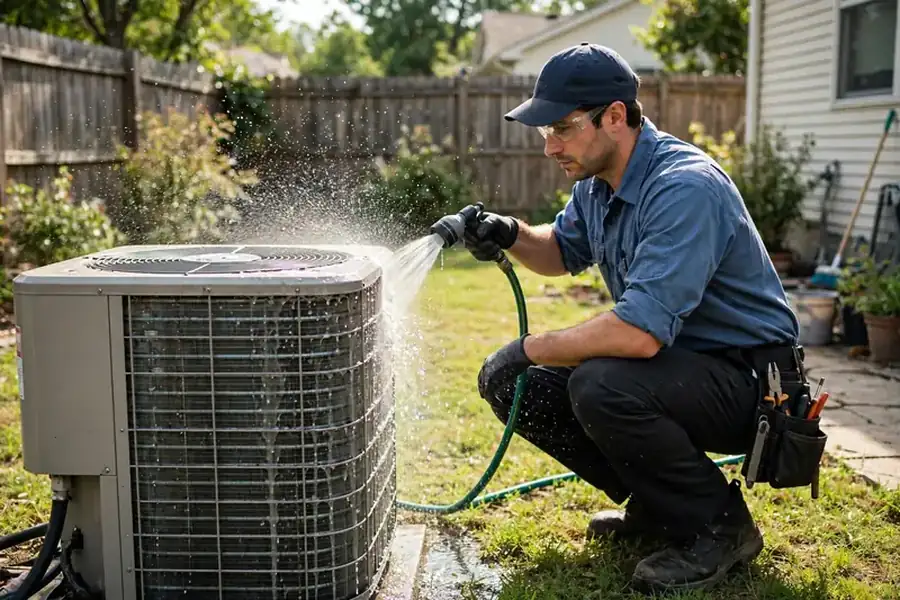
- Check the outdoor unit for packed grass clippings or debris choking the coil.
- Wait. Give it at least 4 hours – a heavily iced coil can need up to 24. Put towels around the indoor unit; melting ice makes a mess.
- Restart and watch. If ice returns within a day or two, call us. The root cause is still there.
Ice vs. Normal Sweat: How to Tell
| What you're looking at | Normal condensation | Trouble |
|---|---|---|
| Copper refrigerant line outside | Damp with light sweat | Coated in thick white ice |
| Indoor evaporator coil | Wet to the touch | Frost or ice buildup on the fins |
| Air from the vents | Cool and steady | Warm, or airflow that keeps weakening |
| Water near the air handler | A small drip from the drain line | Puddles plus visible ice on the unit |
| System sound | Normal hum and airflow | Gurgling, or the outdoor unit straining |
What We Check on a Freeze-Up Call
When the filter isn't the answer, we dig deeper. We measure refrigerant pressures and compare them to the manufacturer's charging chart – low readings with a temperature split point to a leak, which we then locate rather than just refilling. We check static pressure across the blower, because a weak blower motor or a filthy blower wheel moves too little air even with a clean filter. And we inspect the metering device, since a stuck expansion valve can starve the coil and freeze it from the inside. Older flex duct run through 130-degree Antioch attics is another classic: it sags and kinks over the years, strangling airflow to whole sections of the house.
The Myth That Wrecks Compressors
Some folks figure that if the system is struggling, they should just keep it running and "push through" the ice. Please don't. A frozen coil sends liquid refrigerant back to a compressor designed for vapor, and compressors fail from that abuse. The other myth we hear: that adding refrigerant fixes freezing. Low charge is only one possible cause – and since refrigerant never gets "used up," a low charge means a leak that needs repairing, not a can of refrigerant and a handshake.
Your Questions, Answered
How long does it take a frozen AC to thaw?
Typically 4 to 12 hours with the system switched off and the fan left running. A badly iced coil – the kind with an inch of frost on the lines – can take up to 24 hours to thaw fully. Put towels down around the indoor unit, because all that ice turns into water.
Can I pour hot water on the frozen coil to thaw it faster?
No. Thermal shock can crack the coil, and water around electrical components is a genuine safety hazard. The indoor fan blowing room-temperature air across the coil is the fastest safe method. Patience beats a shortcut here.
My AC keeps freezing even with a new filter. Why?
Then airflow from a dirty filter probably isn't the issue. Low refrigerant from a leak, a weak blower motor, a caked blower wheel, or a stuck metering device can all freeze a coil with a perfectly clean filter. At that point a technician needs to measure refrigerant pressures and airflow to find the real cause.
Does a frozen AC mean I need refrigerant added?
Not automatically. Low charge is one possible cause, but it's never the only suspect – and since refrigerant is only ever low when there's a leak, adding refrigerant without repairing the leak is a short-lived patch. Get the leak found and fixed, then charge to spec.
Is a frozen AC an emergency?
Turn the system off first, then judge. If thawing and a fresh filter solve it, you're fine to schedule a regular visit for a check-over. If it refreezes, don't keep running it – a frozen system risks compressor damage, the most expensive repair in the whole unit. Call (615) 637-1254 and we'll get it sorted.